FAQ
1. How Does Laptop Rental Work?
Laptop Rental Typically Involves Selecting A Laptop Model, Rental Duration, And Providing Necessary Identification And Payment Information. Once The Rental Is Confirmed, You Can Pick Up Or deliver The Laptop To Your Desired Location.
2. What Are The Benefits Of Renting A Laptop?
Renting A Laptop Can Be Beneficial In Several Ways. It Allows You To Access The Latest Technology Without Making A Long-Term Commitment. It's Cost-Effective For Short-Term Needs, Such As Events, Presentations, Or Travel. Renting Also Provides Flexibility In Terms Of Equipment Upgrades And Maintenance.
3. What Information And Documents Are Required For Laptop Rental?
You'll need To Provide a Valid ID (Such As a Driver's License or Passport), Proof Of Address, And A Credit Card For Payment And Security Deposit Purposes.
4. Can I Rent A Laptop For Personal Use?
Whether You Need A Laptop For Personal Projects, Travel, Or Temporary Replacement, Renting Is A Viable Option.
5. Can I Rent A Laptop For Business Or Corporate Use?
Absolutely. Businesses Commonly Use Laptop Rentals for Events, Conferences, Temporary Employees, and Projects.
6. Are Rental Laptops New Or Used?
Rental Laptops in Good Working. Depending On Availability And Budget, You Can Often Choose Between New And Refurbished Models.
7. What Is The Rental Duration For A Laptop?
The Rental Duration Is Typically Flexible And Can Range From A Few Days To Several Months.
8. Can I Extend The Rental Period If Needed?
In Most Cases, Yes. If You Need To Extend the Rental Period, It's Usually Possible,
10. Why Do I Need To Pay An Additional Security Deposit?
We Hope You Will Handle The Items Carefully, But The Deposit Is A Safety Net For The Lender If Something Goes Wrong. The Deposit Builds Trust and Increases the Incentive for the Lender to Share His/her Item. We Will Initiate The Deposit Refund As Soon As We Receive The Products From The Customer.
11. How Can I Pay The Rental Amount?
The Rent Can Be Paid Through A Debit Card/ Credit Card, Mobile Wallet Paytm, Amazon Pay, Ola Money Net Banking, And UPI.
12. What Is The Approximate Time For Delivery?
After You Complete The Payment And The Mandatory KYC Procedure, Our Customer Support Team will contact you to schedule a delivery date when convenient. Once Done, Your Order Will Be Delivered Within 24 - 48 Hours. Please Check The Status Of Your Order On Your Dashboard For Further Updates Or View It Here. If you need any more help, Please Use the Chat Feature on the Website/App abcom.in
13. How Can I Track My Order?
Once Your Order Has Been Dispatched From Our Warehouse, You Will Receive An Email And SMS With The Tracking Link To Track Your Order Status. You Can Also Track Your Orders From Your Account On Www. Abcom, in, Our Website.
14. What Are The Documents Required For KYC Verification?
As Part Of Abcom’s Know Your Customer (KYC) Process, You Must Upload The Following Documents/Details Below After Making The Payment: Profession (Student / Freelancer / Self-Employed / Employed / Homemaker / Other) Govt. ID (Aadhar Card / Driving License / Passport) Address Proof (Rental Agreement / Electricity Bill / Wi-Fi Bill / Aadhar Card / Passport) Secondary Contact (Friend / Family / Colleague) Based On The Profession Selected (College Detail / Work Detail / Employment Detail)
15. How Can I Get An Invoice For The Rental Payments That Have Been Made?
For Every Payment That Has Been Initiated and Completed, You’ll Be Able to Get the Invoice by Accessing Your Account on Abcom. You Can Download The Invoice By Visiting My Profile → My Orders → Invoice.
Laptop rental vs. buying a laptop: an honest comparison
Pricing out a new laptop and feeling your stomach drop is a pretty universal experience. Every month, we talk to students, freelancers, and HR managers staffing up a new team who are stuck on the same question — pay a large amount upfront and own the machine, or pay a small amount each month and rent it instead.
There's no single right answer here. It depends on how long you actually need the laptop, how your cash flow works, and how much patience you have for hardware problems. Below is a plain, point-by-point comparison, followed by a section on when buying genuinely is the better call.
The quick comparison
Here's how the two options stack up across the things that actually matter day to day — not just the price tag.
| What you're deciding | Buying a laptop | Renting from ABCOM Most chosen |
|---|---|---|
| Money upfront | →You pay the full price before you've even switched it on — often somewhere between ₹40,000 and ₹1,50,000 depending on the spec. | →Plans start around ₹849 a month for an everyday office laptop and ₹1,349 a month for a gaming laptop, so you only pay for the time you use it. |
| Cash flow | →That money is now tied up in a machine that starts losing value the moment you open the box. | →The cash stays free for whatever your business or studies actually need it for. |
| Repairs & maintenance | →Every repair, replacement part, and service visit is your responsibility — and your cost. | →Maintenance, repairs, and replacements are built into the rental, so a hardware issue doesn't turn into a hardware bill. |
| Getting started | →You're setting up the OS, drivers, and software yourself before you can do any real work. | →The laptop arrives tested and ready, with software, settings, and tools like MS Office pre-loaded on request. |
| Flexibility | →You're committed to this exact machine, deposit-free or not, for as long as you own it. | →Rent for a day, a week, or a month — with no-deposit plans available if you'd rather not lock up extra cash. |
| Scaling for a team | →Hiring five more people this quarter means buying five more laptops this quarter. | →Corporates and event organizers can rent in bulk and scale the fleet up or down as headcount changes. |
| When you're done with it | →Reselling or recycling the laptop responsibly is now your job. | →You hand it back. Reusing the same hardware across renters also means less electronic waste overall. |
| Accounting treatment | →Usually capitalised as a fixed asset and depreciated over several years. | →Often booked as a straightforward operating expense — worth confirming the exact treatment with your CA. |
| Best suited for | →Long-term personal ownership, where the specs won't need to change for years. | →Students, freelancers, growing teams, and short-term projects where flexibility matters more than ownership. |
Rental rates shown are indicative and correct at the time of writing — check abcom.in for current pricing.
Going through each point
The real cost difference
Buying looks simple on paper — pay once, own it forever. But "once" is a big number, and it arrives before you've earned a single rupee back from the laptop. Renting spreads that same cost into small, predictable payments, which is exactly why it tends to suit short projects, students on a budget, and businesses that would rather keep cash free for things like salaries and rent than have it sitting inside a depreciating asset.
Who deals with repairs and maintenance
Laptops eventually need a new battery, a keyboard fix, or a software clean-up. When you own the machine, finding a technician and paying for the part is on you. With a rented laptop, that responsibility shifts to the provider — at ABCOM, repairs, replacements, and technical support are part of the plan, not an add-on bill.
How fast you can actually start working
A brand-new laptop usually needs an hour or two of setup before it's useful — operating system updates, drivers, antivirus, the software you actually need. A rented laptop from ABCOM can arrive with the basics, and tools like MS Office, already in place, so you're working sooner rather than configuring sooner.
Flexibility if your plans change
Buying assumes you know exactly how long you'll need the laptop. Renting doesn't ask you to guess. You can take a laptop for a single day, a month-long project, or longer, and some plans don't even require a security deposit — useful if you'd rather not lock up extra money on top of the rental itself.
What happens to the laptop afterwards
Once you own a laptop, getting rid of it responsibly — reselling it, recycling it, making sure old data is wiped — becomes your problem. With a rental, you simply return it. Because the same machine often goes on to serve the next renter, fewer new devices need to be manufactured overall, which is a quieter but real environmental upside.
Tax and accounting treatment
This is the one area where it genuinely pays to ask a professional rather than take a guide's word for it. Purchased laptops are typically capitalised as a fixed asset and depreciated over time, while rental payments are often treated as a simple operating expense. The right treatment depends on your business structure, so loop in your CA before assuming either way.
When buying still makes sense
Renting isn't the answer for everyone, and it's worth saying that plainly. If you know you'll be using the same laptop heavily for several years, want full control to upgrade or repair it however you like, or simply prefer owning your equipment outright, buying can work out more cost-effective over the long run. Renting earns its value in exactly the opposite situation — when your timeline is uncertain, your needs might change, or you'd rather not tie up capital in hardware that loses value every year.
Frequently asked questions
Is renting a laptop cheaper than buying one in India?
For short and medium-term use, yes — renting avoids the large upfront payment and bundles in maintenance, so the day-one cost is far lower. For multi-year personal ownership with heavy use, buying can work out cheaper over time. It really comes down to how long you need the laptop for.
Do I need to pay a security deposit to rent a laptop from ABCOM?
Not always. ABCOM offers laptop rental plans without a security deposit alongside standard plans, so you can pick whichever suits your budget and rental duration.
Can I rent a laptop for just one month?
Yes — rentals are available by the day, week, or month, so you only pay for the time you actually need the device.
What happens if a rented laptop gets damaged or stops working?
Our support team handles repairs, replacements, and technical issues as part of the rental, so you're not left covering a surprise repair bill on your own.
Can a company rent laptops in bulk for a new team or event?
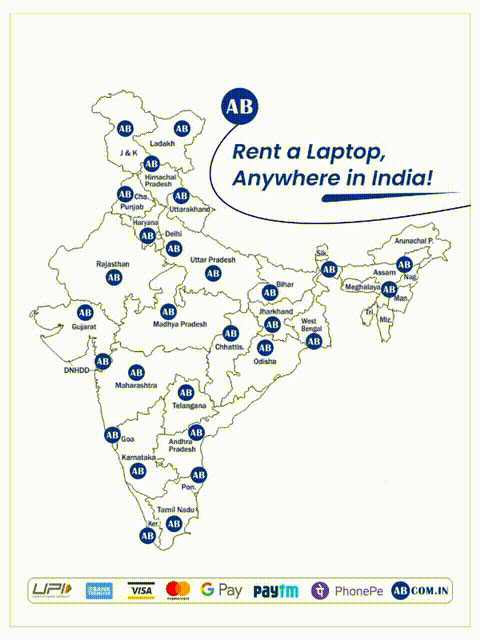
Yes — we work with corporates, event organizers, and startups to provide laptops in bulk, with delivery across 250+ cities in India.
Not sure which way to go?
Tell us how many laptops you need and for how long, and we'll work out what makes more sense for your situation — renting, buying, or a mix of both.